
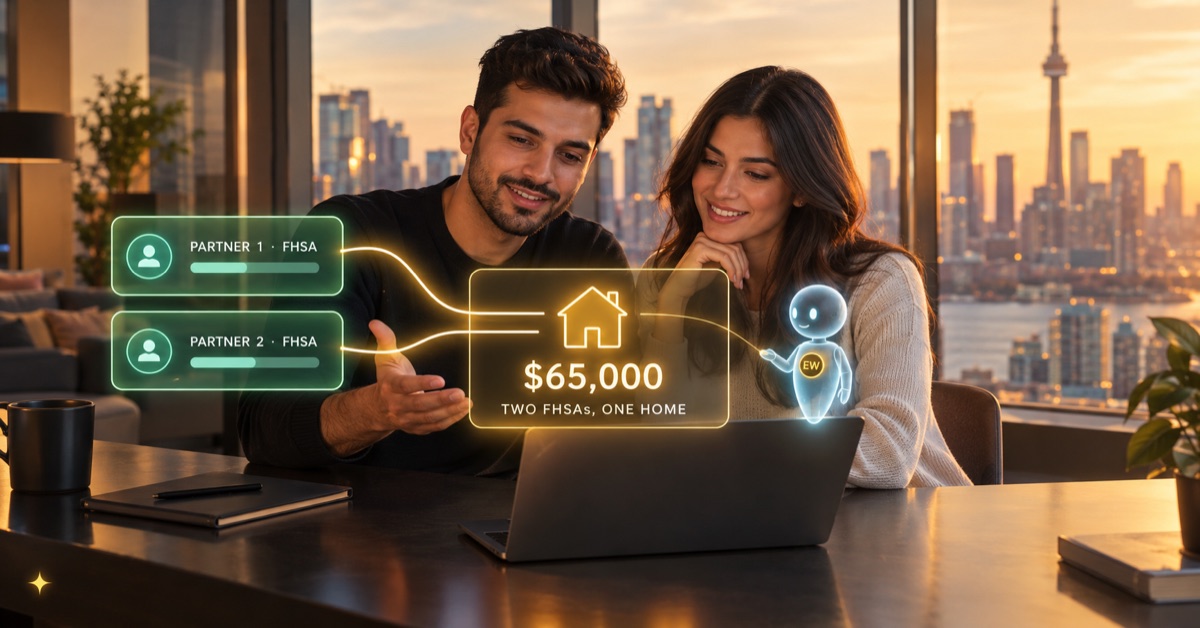
FHSA for Couples: How Two FHSAs Work for One Home, and What Moving In Changes
Two partners, two accounts, one house. Who can open an FHSA, who can withdraw, and why the order of steps matters.
Both partners can open an FHSA, and both can make a qualifying withdrawal for the same home, each from their own account. Timing is the catch: you cannot open one while living in a home your spouse or common-law partner owns, but an FHSA you already hold can still go toward a home you buy together.
The reason is that the Canada Revenue Agency uses two different first-time home buyer tests: one when you open an FHSA, and another when you take money out. This guide walks through both, how the Home Buyers' Plan fits in, and what changes when one of you already owns a home. Which account to fill first is covered in TFSA vs RRSP vs FHSA for a house down payment, so it is not repeated here.
1. Can both of you open an FHSA?
Yes, as long as each of you qualifies on your own. An FHSA belongs to one person. The CRA says only the holder can contribute directly to their own FHSA, and only the holder can claim those contributions as a tax deduction.
To open one, you need to be a resident of Canada, meet the age rule, and be a first-time home buyer. For opening an account, that test has two parts:
- You did not live in a home you owned or jointly owned as your principal residence at any time this calendar year or in the previous 4 calendar years.
- And either you did not live in a home your spouse or common-law partner owned or jointly owned as your principal residence in that same window, or you do not have a spouse or common-law partner when you open the account.
Each of you then has your own room. It is $8,000 in the year you open your first FHSA and $8,000 more in each later year, and up to $8,000 of unused room can carry forward. The lifetime limit is $40,000 per person. Room starts in the year you open your first FHSA, not before, so a partner who has not opened one is not building any.
Two words matter here. For these rules, a spouse is someone you are legally married to. A common-law partner is someone you live with in a conjugal relationship who has lived with you that way for at least 12 continuous months, or who is the parent of your child, or meets one of the other conditions the CRA lists.
Sources: Canada Revenue Agency, Opening your FHSAs; CRA, Participating in your FHSAs; CRA, Definitions for FHSAs. Accessed October 2026.
2. The opening test and the withdrawal test are not the same
This difference is the heart of the couples question. The CRA asks a different question when you open an FHSA than when you take money out of it for a home.
Opening: your partner's home counts
When you open an FHSA, a home your spouse or common-law partner owns counts against you if you lived in it as your principal residence this year or in the previous 4 calendar years. The partner who counts is whoever is your spouse or common-law partner on the day you open the account.
The CRA's own example: Carlos lives with his common-law partner in a home his partner owns. Because his principal residence is owned by his common-law partner, he is not a first-time home buyer, and he cannot open an FHSA.
Withdrawing: only your own home counts
For a qualifying withdrawal, the CRA only looks at homes you owned or jointly owned and lived in as your principal residence, at any time this calendar year before the withdrawal (not counting the 30 days just before it) or in the previous 4 calendar years. Your partner's home is not part of this test.
The CRA's example: Joshua opened an FHSA in April 2025 and put in $8,000. He had never owned a home. In May he married Lisa, and he lived with her in a condo she owned. In July they signed an agreement to buy a home together, and Joshua withdrew his $8,000 that month. The CRA says the fact that Joshua lived in a condo his wife owns "is not relevant" to whether he can make a qualifying withdrawal. He met every condition, so the withdrawal was not added to his income.
Why the order of steps matters
Put those two rules side by side and the sequence decides the outcome. An FHSA opened before you live in a home your spouse or common-law partner owns can still be used for a qualifying withdrawal later, if you meet the other conditions. Try to open one after that point, and the opening test stops you.
Sources: CRA, Opening your FHSAs (Carlos example); CRA, Withdrawals and transfers out of your FHSAs (Joshua example); CRA, Definitions for FHSAs. Accessed October 2026.
3. Using two FHSAs, and the HBP, for one home
When you buy or build a home together, the CRA says both of you can make a qualifying withdrawal from your own FHSA, as long as each of you meets all the conditions. Each of you can take out some or all of what is in your own account. The CRA's example has common-law partners, Kara and Stephen, each withdrawing from their own FHSA for the same house, with neither withdrawal added to their income.
The conditions each partner has to meet for a qualifying withdrawal:
- Be a first-time home buyer under the withdrawal test above.
- Have a written agreement to buy or build a qualifying home, with the purchase or completion date before October 1 of the year after the withdrawal.
- Not have bought the home more than 30 days before the withdrawal.
- Be a resident of Canada from your first qualifying withdrawal until you buy the home.
- Live in the home as your principal residence, or intend to, within one year of buying or building it.
- Fill out Form RC725 and give it to your FHSA issuer.
Adding the Home Buyers' Plan
The CRA also allows an HBP withdrawal from your RRSP and an FHSA qualifying withdrawal for the same home, as long as you meet the conditions of each at the time of each withdrawal. The HBP limit is $60,000 in total from your own RRSPs.
Unlike an FHSA withdrawal, an HBP withdrawal has to be paid back. You have up to 15 years, and in any year you repay less than the required amount, the shortfall is added to your income. For withdrawals made from 2026 to 2028, the federal government has extended the grace period before repayments start from two years to five.
The HBP's first-time buyer test is stricter for couples than the FHSA withdrawal test. Like the FHSA opening test, it counts a home your spouse or common-law partner owned. The difference is that it is checked at the time of the HBP withdrawal, against whoever is your spouse or common-law partner then.
How the FHSA, a TFSA and the HBP compare for a down payment, and how the HBP sits against retirement saving, is covered in TFSA vs RRSP vs FHSA for a house down payment.
Sources: CRA, Withdrawals and transfers out of your FHSAs (Kara and Stephen example); CRA, What is the Home Buyers' Plan; CRA, How to participate in the Home Buyers' Plan; CRA, How to repay amounts withdrawn under the Home Buyers' Plan; Department of Finance Canada, Legislation passes to implement measures from the Spring Economic Update 2026 (June 19, 2026). Accessed October 2026.
4. When one partner already owns a home
Say one of you owns the home you both live in, and together you want to buy a different one. The two of you are in different positions.
The partner who owns
Someone who lived in a home they owned or jointly owned, this year or in the previous 4 calendar years, fails the first-time buyer test for opening an FHSA, for a qualifying withdrawal, and for the HBP. The window counts whole calendar years, so it can run longer than it sounds. In the CRA's example, Aysha co-owned and lived in a home from 2021 to 2024, and cannot open an FHSA until at least 2029.
The partner who does not own
If you live in your partner's home as your principal residence and they are your spouse or common-law partner:
- Opening an FHSA: not possible while that home is inside the look-back window. This is the Carlos example.
- A qualifying withdrawal from an FHSA you already hold: your partner's ownership is not relevant. This is the Joshua example.
- The HBP: not possible. The CRA says that if your current principal residence is a home owned and occupied by a new spouse or common-law partner, you cannot make an HBP withdrawal. In its example, Jaspreet has never owned a home but has lived for two years with her common-law partner, Mark, in a home he owns, so she is not a first-time buyer for the HBP.
So for this couple, the account that matters is an FHSA the non-owning partner opened before moving into the other's home. Without one, the tests above leave neither partner able to open an FHSA or use the HBP for the new home. The HBP does have separate exceptions, for example for partners who live separate and apart, which this guide does not cover.
Sources: CRA, Opening your FHSAs (Aysha and Carlos examples); CRA, Withdrawals and transfers out of your FHSAs; CRA, How to participate in the Home Buyers' Plan; CRA, The Home Buyers' Plan: understanding eligibility and withdrawals (Jaspreet example). Accessed October 2026.
5. One couple, a wedding and a home: the numbers
Illustrative example only, not tax advice. Figures are rounded and leave out investment growth and taxes.
This is the same couple from can you use an FHSA for a wedding: $7,800 a month in combined take-home pay, a $65,000 down payment target in 5 years, and a $32,000 wedding in 16 months. Neither of them has ever owned a home. In that post, one FHSA was already open. Here, both partners hold one.
- First partner's FHSA, home: $6,500 a year, about $542 a month.
- Second partner's FHSA, home: $6,500 a year, about $542 a month.
- Together for the home: about $1,084 a month. After 5 years that is $32,500 in each FHSA, $65,000 in total.
- Room check: $6,500 a year is under each partner's $8,000 of yearly room, and $32,500 is under each partner's $40,000 lifetime limit. That leaves $15,000 of their combined lifetime room unused.
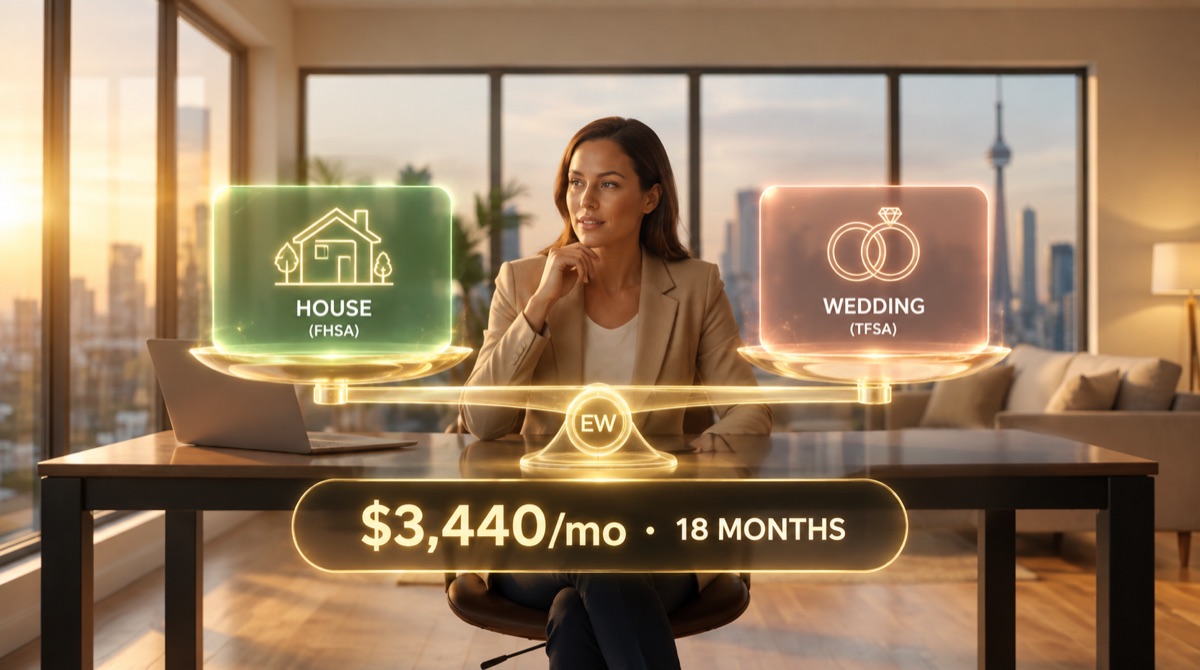
- Wedding, in a TFSA or savings: $32,000 over 16 months is $2,000 a month.
- During the overlap (months 1 to 16): $1,084 + $2,000 = $3,084 a month, about 40% of take-home pay.
- After month 16: back to $1,084 a month for the home, about 14% of take-home pay.
The monthly amount for the home is the same as in the one-FHSA version of this plan. What changes is where it sits. All $65,000 is in FHSAs, where contributions are generally deductible and a qualifying withdrawal is not added to income. None of the couple's TFSA room goes to the house, so it is all available for the wedding.
To see what the wedding and the home need each month together, add both to the calculator.
EnvisionWorth plans goal amounts and monthly needs and lets you give each FHSA the home as its purpose. It does not model FHSA deductions, HBP repayments or taxes.
6. Opening test vs withdrawal test vs HBP
| Test | Whose home counts | Time window checked | If you live in a home your spouse or common-law partner owns | Paid back? |
|---|---|---|---|---|
| Opening an FHSA | Yours, and your spouse's or common-law partner's on the day you open it | This calendar year before opening, and the previous 4 calendar years | You cannot open one | Not applicable |
| FHSA qualifying withdrawal | Only homes you owned or jointly owned | This calendar year before the withdrawal (except the last 30 days), and the previous 4 calendar years | Not relevant | No |
| HBP withdrawal | Yours, and your spouse's or common-law partner's at the time of the withdrawal | This calendar year before the withdrawal (except the last 30 days), and the previous 4 calendar years | You cannot make one | Yes, over up to 15 years |
Sources: CRA, Definitions for FHSAs; CRA, How to participate in the Home Buyers' Plan; CRA, How to repay amounts withdrawn under the Home Buyers' Plan. Accessed October 2026.
Frequently asked questions
Can I put money into my partner's FHSA?
Not directly. The CRA says only the holder can contribute to their own FHSA, and only the holder can claim the deduction. You can give your partner money that they then contribute to their own FHSA. Under the Income Tax Act, the attribution rules do not apply to that money while it is held in their FHSA, as long as they do not have an excess FHSA amount when it goes in.
Do we each get our own $40,000 FHSA limit?
Yes. The $40,000 lifetime limit, the $8,000 of room each year and the carryforward of up to $8,000 are all per person, and each partner's room starts in the year they open their first FHSA. Two partners who both open one have up to $80,000 of lifetime room between them, and the CRA allows both to make a qualifying withdrawal for a home they buy together, as long as each of them meets all the conditions.
If my partner owns our home, can I still use the Home Buyers' Plan?
Not if you have lived in that home as your principal residence this calendar year or in the previous 4 calendar years, and your partner is your spouse or common-law partner when you withdraw. The CRA says you cannot make an HBP withdrawal if your current home is owned and occupied by a new spouse or common-law partner. An FHSA you already hold works differently: your partner's ownership does not affect a qualifying withdrawal from it.
FAQ sources: CRA, Participating in your FHSAs; Income Tax Act, paragraph 74.5(12)(c); CRA, Definitions for FHSAs; CRA, How to participate in the Home Buyers' Plan. Accessed October 2026.
If a wedding and a home are landing in the same few years, can you afford a house and a wedding in the same year walks through the monthly math of funding both at once.
See your goals on one page
The EnvisionWorth calculator prices each of your financial goals on its own timeline and adds them into one monthly Dream Number, then shows where two goals compete for the same dollar and what a what-if change (delaying, resizing, or reordering a goal) does to the rest. It runs in your browser, and no account is needed to see your number.
Try the free calculator⚠️ Disclaimer
This content is for educational purposes only and does not constitute financial, investment, tax, or legal advice. EnvisionWorth provides technology and educational resources; we do not provide personalized financial advice. Past performance does not guarantee future results. All investment decisions should be made in consultation with qualified financial professionals.
Avish Shah
Founder, EnvisionWorth Financial Intelligence
EnvisionWorth helps you plan all your financial goals together, give every dollar a job toward a goal, and see what needs attention.
Continue Your Journey
Explore more insights to enhance your financial intelligence
Can You Afford a House and a Wedding in the Same Year?
Two goals that look affordable separately can be impossible together. The month-by-month numbers on funding a house deposit and a wedding at once, and the three ways out.

TFSA vs RRSP vs FHSA for a House Down Payment: Which Should Hold Your Money?
FHSA, RRSP Home Buyers' Plan, or TFSA: the CRA rules for each, the order that gets first-time buyers to a down payment fastest, and a worked Canadian example that keeps retirement funded too.

Can You Use an FHSA for a Wedding? The Real Tax Cost If You Try
An FHSA withdrawal for anything but a qualifying home is fully taxable, and the room does not come back. The CRA rules, the real cost of getting it wrong, and where wedding money should sit while the house goal keeps building.